
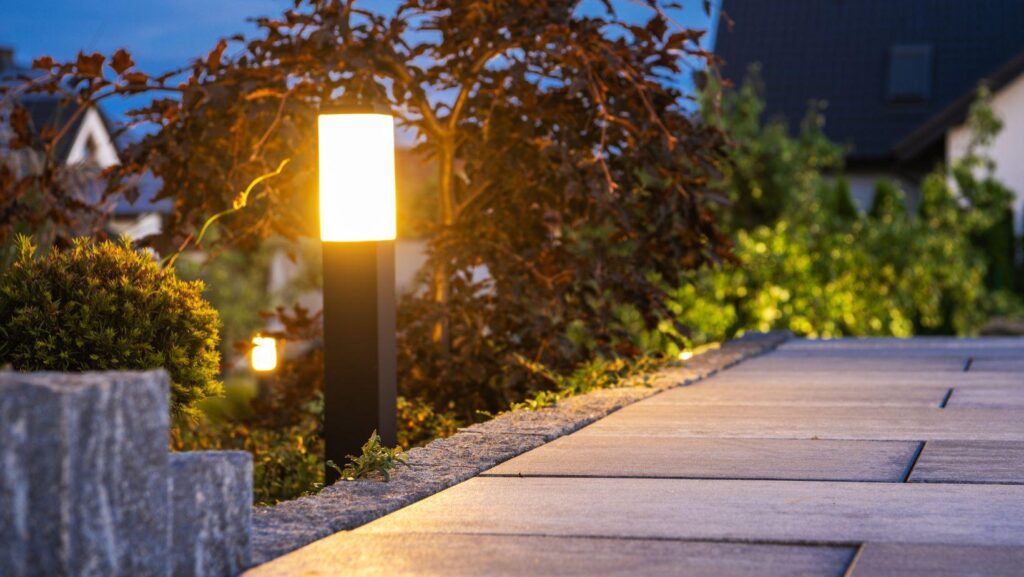
Solar path lights, plug-in low-voltage systems, screw-in motion sensor adapters, and battery-powered security lights can all be installed by a landlord with a screwdriver and an afternoon. None of them involve opening a junction box, running new circuits, or touching line voltage, which is the boundary where licensed work legally begins in most jurisdictions.
That boundary matters more than most property owners realize. Low-voltage systems running at 12 volts and solar units with no mains connection generally fall outside permit requirements, while anything hardwired to your building’s electrical system typically does not, regardless of how simple the fixture looks. Your local code is the final word, so a quick call to the building department costs nothing and settles the question for your specific property.
What You Can Install Yourself and What Still Needs a Licensed Trade
The clean test is whether the work touches 120 volt wiring. Replacing a bulb, adding a screw-in adapter, plugging a transformer into an existing exterior GFCI outlet, mounting a solar fixture, or attaching a battery-powered light to a wall are all owner-installable in nearly every jurisdiction. Adding a new exterior outlet, replacing a hardwired wall sconce, installing a flood light on an existing circuit, or running conduit are not.
The gray area is swapping a like-for-like hardwired fixture. Some jurisdictions treat it as maintenance, others treat it as electrical work requiring a permit, and for a rental property specifically, the calculus is different than for your own home. If a tenant is later injured and your insurer discovers unpermitted electrical work, that becomes an expensive conversation. The no-electrician approaches below sidestep the issue entirely.
One thing to rule out immediately: permanently running an extension cord to power outdoor lighting is a code violation almost everywhere, an insurance liability, and a genuine fire risk. Temporary means temporary.
Plug-In Low-Voltage Systems Using an Outlet You Already Have
If the property has a working exterior GFCI outlet, a low-voltage landscape kit is the highest-impact upgrade available without a trade. A transformer plugs into that outlet, steps 120 volts down to 12, and everything downstream of it is safe to handle and simple to bury a few inches deep. Most kits come with the transformer, cable, and fixtures in one box.
Installation is genuinely straightforward. Lay the cable along the route, connect fixtures with the pierce-style or screw-down connectors supplied, and stake everything in place. Wire can be buried 3 to 6 inches deep in a shallow trench cut with a flat spade, or tucked under mulch beds where landscape crews are unlikely to hit it. A 100 to 300 watt transformer with a built-in photocell or astronomical timer handles anywhere from eight to twenty modern LED fixtures, since each one draws only 2 to 5 watts.
Expect to spend $150 to $500 for a decent eight-fixture setup and roughly three to five hours the first time you do one. The main limitation is that everything must reach back to that one outlet, so properties with an outlet only at the rear patio may not be able to light the front walkway this way.
Solar Lighting Where No Outlet Exists, and How to Avoid the Cheap Ones
Solar removes the outlet constraint completely, which makes it the default answer for side yards, back fences, detached garages, driveways, docks, and any rural or waterfront property where the nearest power is a long way off. Installation is usually a stake pushed into the ground or four screws into a post.
The catch is that the solar category is split into two very different products sold side by side. The $12 stake lights from a big box store typically use small NiMH battery packs and undersized panels, put out 5 to 20 lumens, and are commonly dead within one or two seasons, particularly in northern climates where winter output can drop by half or more. Replacing eight of them every year is not cheaper than buying properly once.
Better systems, including the USA-made fixtures from Suntino Solar Lights, use lithium iron phosphate batteries, larger panels, and sealed housings rated IP65 or higher, which is what allows them to run through multiple winters and survive dock spray or sprinkler contact. Expect $60 to $150 per fixture at that tier, with a service life measured in years rather than months. Whatever you buy, the panel needs six or more hours of direct sun, so mounting one under a soffit or beneath a mature maple will underperform no matter what is printed on the box. Give any new solar installation two or three full days to reach a proper charge before you judge its brightness.
Screw-In and Battery Upgrades for Doorways, Stairs, and Entries
Existing exterior fixtures can be upgraded without touching wiring at all. A screw-in motion sensor adapter sits between the socket and the bulb and converts a plain porch light into a motion-activated one in about a minute. Dusk-to-dawn photocell bulbs do the same for automatic operation, which solves the perennial problem of tenants who never turn the porch light on.
Battery-powered LED security lights with rechargeable lithium packs have improved enough to be a serious option, typically running 400 to 1,200 lumens on motion activation with several months between charges depending on traffic. They mount with four screws anywhere you can reach, including places no circuit was ever run, which makes them useful for parking areas, side gates, and basement entrances.
For stairs and thresholds, small stick-on or stake-mounted lights at each riser and landing address the specific hazard that actually generates injury claims. This is where property type changes the priorities. A single-family rental usually needs the front walk and entry handled well and little else. A small multifamily building has shared stairs, a shared parking area, and often a common walkway, all of which are your responsibility rather than any tenant’s, and many jurisdictions have habitability requirements covering lighting in common areas of multifamily housing. A short-term or mid-term rental has an entirely different problem, which is guests arriving after dark at an address they have never seen, doing self check-in with a lockbox they cannot find.
What This Actually Returns
Lighting is one of the few upgrades that shows up in three places at once. It reduces the slip-and-fall exposure that dark walkways create, it makes listing photos and virtual tours substantially better, and it consistently appears in the small comments that shape whether a tenant renews or a guest leaves a five star review. Property managers generally report that arrival experience complaints drop sharply once entry and parking areas are properly lit.
Timing matters for a rental. Do this work between tenants, when you have unrestricted access and no scheduling negotiation, and photograph the result the same week for your listing. Total cost across a modest single-family property lands somewhere between $200 and $700 depending on how much ground you cover, against the $150 to $400 an electrician typically charges for a single hardwired fixture install before the fixture itself.
Before buying anything, walk the property once at 9pm on a moonless night and note exactly where you feel uncertain about your footing. That walk tells you more than any product page will, and it usually reveals that the problem is two or three specific spots rather than the whole lot, which keeps the budget honest and the install to a single afternoon.