
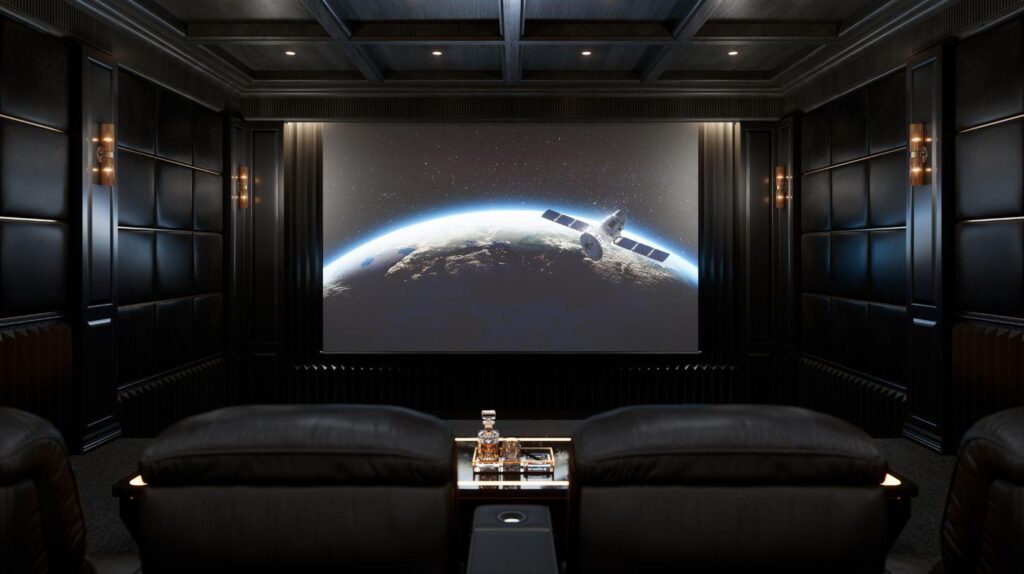
Most home cinema plans start with the screen and the speakers. The seating tends to be decided last, yet it is the part of the room people touch every time they use it, and the part that decides whether a film night feels like a treat or an endurance test.
There are two main ways to seat a cinema room: individual cinema seats arranged in rows, or a cinema sofa that gives everyone one continuous surface. Both can recline, both can carry cup holders and charging points, and both can look very good. They suit different rooms and different households, and the choice is easier once you know where the differences lie.
What makes a cinema sofa different from a living room sofa
A cinema sofa is built around long viewing sessions. Compared with an ordinary sofa, it usually offers deeper reclining positions, adjustable headrests and, on many models, cup holders and charging built into the arms or a console. The aim is to keep you comfortable through a two-and-a-half-hour film without anyone shifting around for a better angle.
It still reads as a sofa, though. When the projector is off, the room looks like a lounge rather than a private screening room, which matters if the space has to do more than one job.
Cinema sofa or individual cinema seats?
Individual cinema seats give every viewer their own recliner, their own pair of armrests and usually their own storage. They suit a dedicated room where sightlines matter and the seating is arranged in fixed rows facing the screen.
A sofa works differently. People can sit closer together, spread out, or lie across the cushions, and children can pile on without anyone being squeezed into a gap between armrests. If the room also has to work as a family space, a cinema sofa is usually the more flexible answer, especially in a modular or corner layout that can be shaped around alcoves and speaker positions.
A simple test helps: if the room will only ever be used for films, seats make sense; if it will host board games, naps and Sunday afternoons as well, choose a sofa.
Sizing the seating to the room
Start with the screen rather than the walls. A row of seating that is wider than the screen forces the people at either end into an uncomfortable angle across the picture, so the width of the sofa should be set against the viewing distance and the screen size, not simply against the length of the wall.
Reclining seating also needs room to move. Allow roughly 50 cm in front of each reclining seat for the extended footrest, and enough space behind for the back to travel. A standard reclining sofa cannot be pushed flat against the wall; only designs specified as wall huggers, which slide forward as they recline, can sit close to it.
Two-seat configurations suit smaller rooms, while three- and four-seat designs, corner layouts and modular arrangements suit larger spaces and bigger families.
Mechanisms and features worth paying for
Electric reclining is the norm in cinema seating. With a single motor, the back and footrest move together, so the back drops as the footrest rises. With a dual motor, the two move independently, which lets you sit upright with your feet up, or recline the back while adjusting the headrest separately.
The headrest matters more than most buyers expect. When the seat is reclined, a powered headrest that tilts forward keeps your eyes on the screen rather than on the ceiling. Storage consoles, cup holders and USB charging are worth checking at the same time, because none of them can be added once the sofa has been made.
Upholstery for a room built around films
Leather wipes clean after drinks and snacks and stays cool through a long session, which is why it is popular in cinema rooms. Fabric feels warmer against the skin and absorbs a little sound rather than reflecting it. Darker colours help in a dedicated room, because they reflect less light from the screen.
Fabric has also become much more practical. Delux Deco, for example, offers water-blocked, stain-resistant and pet-friendly fabrics across its cinema sofa types, which removes much of the worry about spilled drinks.
When the cinema room is also the guest room
Many cinema rooms are converted spare bedrooms, and the guests do not stop coming just because a projector has gone up. A cinema sofa bed reclines for film nights and converts for overnight visitors, so the room keeps both functions without a bed taking up the floor permanently.
Choose the seating format first, then the size, the mechanism and the upholstery. Get those four decisions right and the rest of the cinema room will be far easier to plan around.