
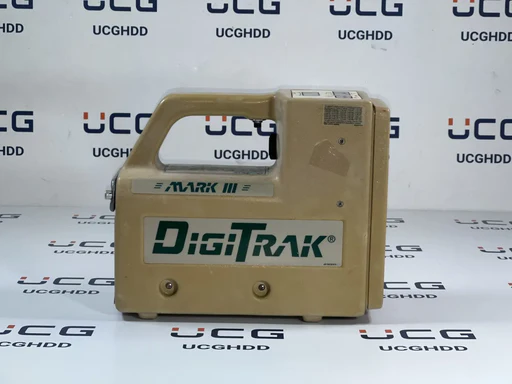
DigiTrak F2 transmitters sondes are locating transmitters used in horizontal directional drilling workflows. Positioned behind the bit inside a pressure-rated housing, the transmitter produces a coded field that is interpreted by a walkover receiver in order to determine the position and orientation of the drill head. The data stream typically includes depth, pitch, roll or clock position for toolface control, along with temperature and status indicators used for routine checks and for logging during pilot shots and as-built documentation.
The operating principle relies on consistent surface measurements of the transmitted field and on calibration suitable for the receiver stance and site grade. When readings are taken at planned intervals, the system enables the driller and locator to maintain line and grade, confirm cover at crossings, and detect drift early. In practice, maintaining a stable receiver height and documenting measurements by drill rod are the common methods for achieving comparable results from entry to exit.
Frequency management is a core aspect of this equipment. F2 compatible units provide hundreds of selectable steps within a span of 4.5 to 45 kHz. Lower portions of the span are generally used where soils are wet or conductive or where surface daylight distance is large; higher portions are used in cleaner ground where sharper peaks may be observed. Before drilling, crews commonly survey the route to determine a primary and a backup frequency and note any segments where band changes are expected due to local electromagnetic influences or surface obstacles.
Telemetry performance is specified up to approximately 550 meters of daylight distance under favorable conditions, acknowledging that soil composition, moisture content, nearby structures, and operator technique can increase or reduce the achievable range. Power is supplied by a lithium-ion battery with a typical continuous runtime of about 10 to 14 hours per charge. Recording expected runtime and scheduling battery changes are standard planning steps for pilots that span multiple shifts or require extended steering in rock.

User interaction is intentionally simple. The transmitter is controlled with a single push button used for power and mode selection. An integrated LCD provides local status information, and an audible beeper offers immediate confirmation in environments where the display may not be visible. Telemetry is available across four channels, providing options for site-specific channel plans and for coordination with nearby equipment.
Environmental and physical characteristics are specified for routine field handling. The stated operating temperature range is −20 to +60 degrees Celsius. Typical measurement accuracy is on the order of five percent, depending on calibration and site conditions. Representative physical dimensions are approximately 28 by 14 by 38 centimeters for height, width, and length, with a mass near 3.5 kilograms including the battery. The associated housings provide fluid flow paths for cooling and are selected to match drill heads and expected ground loads.
Within product families commonly used with F2 receivers, references often include sondes designated FX 12 kHz and FX 19 kHz for work that benefits from longer propagation at lower frequencies, and sondes in the FXL series for extended-range applications where increased output or band flexibility is required. These designations are used to plan frequency strategies in routes that pass under roads or waterways or that traverse areas with variable electromagnetic environments such as rail corridors and substations.
Typical use cases include municipal utility corridors, short urban shots with frequent verification points, and longer crossings where depth confirmation is needed at hold points. In each case, the workflow centers on calibration, a documented frequency plan, consistent receiver stance, and logging by rod. Routine maintenance tasks include inspection of threads and O-rings, removal of fines from vents and recesses, moisture control for stored batteries, and functional checks of the display and beeper before deployment.